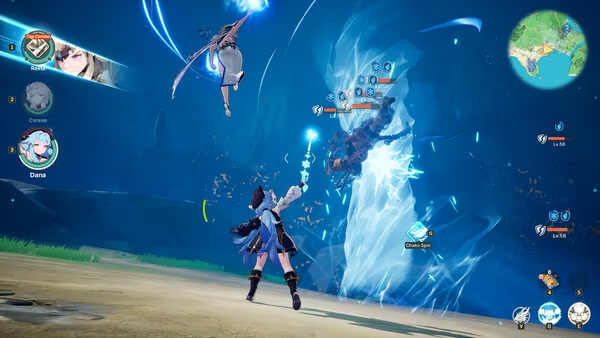
Combat
Win the rhythm before the damage race
Leave one escape
Do not spend every movement and control option at the start of a pattern.
Switch with a reason
Tag for a Signal payoff, a new ailment or a safer position—not just because switching is available.
Watch posture
Large effects are distracting. Read the enemy model and animation wind-up before the damage numbers.
Learn one chain
A consistent two-step handoff is more valuable than five unreliable combos.
Rotate cooldowns
Moving through the party keeps pressure up while individual kits recover.
Reset cleanly
If the setup misses, regain spacing instead of forcing the payoff into the wrong state.
Community-observed behavior: players report that normal attacks can reduce Active Skill cooldowns and that swapping lets the previous hero finish their current action. Confirm exact behavior in your current version, but use it as a reason to stay active rather than waiting passively.
Progression
Build depth before breadth
Fund the active trio
Keep your story team ready before investing equally across all 19 heroes.
Check the reward path
Quests can grant heroes directly or contribute Nameless Souls. Read the reward panel before leaving content unfinished.
Keep replacement logic
When adding a new hero, preserve the setup → answer relationship that made the old team functional.
Delay perfect farming
Use functional upgrades while the story is still opening systems. Optimize sets once a real progression wall appears.
Use the team-building questions before spreading resources, and check the campaign route before farming early.
Exploration
Travel in loops
Choose a main destination, clear discoveries near the route, then return to a hub or story marker. This prevents early exploration from turning into a long detour through content you cannot fully use yet.
- Look beneath watchtowers for the secret cellars mentioned in official game material.
- Gather cooking ingredients as you travel instead of farming one item too early.
- Use Familiars for utility or preference; the free and cosmetic variants do not replace party fundamentals.
- Mark underwater branches or cave routes you cannot finish and revisit them after story progress.
- Combine resident requests with nearby main or hero objectives whenever possible.
Bosses
Use the first attempt as research
Survive one complete cycle
Identify the pause, sound or posture before the largest attacks.
Check the ailment response
Confirm which control states build, trigger or shorten against this target.
Spend burst in the safe window
Hold the strongest Signal chain for a recovery, stagger or clearly completed pattern.
Upgrade the actual weakness
Time-out means damage or uptime; early defeat means survival, spacing or pattern recognition.
PC & performance
Install on an SSD
Hound13's Steam requirements explicitly warn that an HDD may cause extended loading, texture pop-in, frame drops or unexpected crashes. Storage choice is the first performance fix, not an optional polish step.
- OS
- Windows 10, 64-bit
- CPU
- Intel i5-9400F
- Memory
- 8 GB RAM
- GPU
- GeForce GTX 1660
- API
- DirectX 12
- Storage
- 25 GB · SSD required
- OS
- Windows 10, 64-bit
- CPU
- Intel i7-9700F
- Memory
- 16 GB RAM
- GPU
- GeForce RTX 3060
- API
- DirectX 12
- Storage
- 25 GB · SSD required
When troubleshooting: verify Steam files, close unnecessary overlays, update the GPU driver and lower the heaviest visual settings one at a time. Avoid copying “best settings” from a different handheld or GPU class without comparing hardware.